
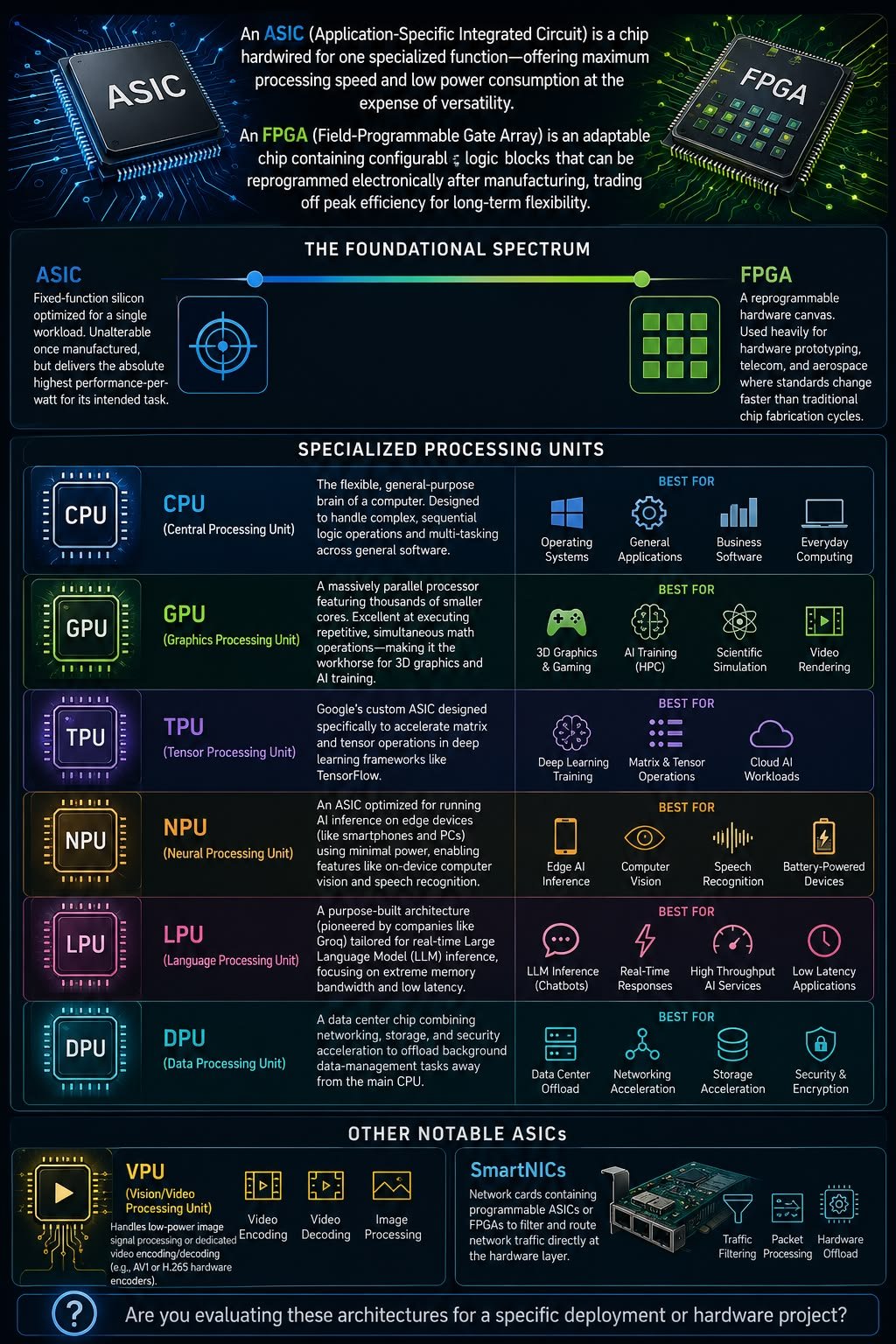
An ASIC, short for Application-Specific Integrated Circuit, is a specialized computer chip designed to perform a particular task or a specific set of tasks. Unlike general-purpose processors such as CPUs, ASICs are built for a dedicated application, which allows them to deliver high performance and efficiency for that workload.
ASIC technology is used in many areas of modern computing, including networking equipment, smartphones, automobiles, telecommunications, artificial intelligence, and specialized computing systems. Understanding ASICs can help you learn how modern electronic devices achieve high performance while using less powe
An ASIC is an integrated circuit created specifically for a particular purpose. Engineers design the chip’s hardware around the tasks it needs to perform.
What Is an ASIC?
For example, a company may develop an ASIC specifically for processing network traffic. Another ASIC could be designed for image processing, encryption, artificial intelligence calculations, or other specialized workloads.
Because an ASIC is optimized for its intended purpose, it can often perform that task more efficiently than a
An ASIC contains electronic components such as logic gates, memory elements, and other circuits designed to perform predetermined operations.
During the design process, engineers define exactly what the chip needs to do. The circuit is then manufactured according to that design.
Once produced, the ASIC performs its intended functions through its hardware rather than relying on software instructions in the same way a CPU does. This specialization can provide advantages in speed, power consumption, and efficiency.
ASIC vs CPU
CPUs are designed to handle many different types of software and tasks. They are flexible and can run operating systems, applications, games, and other programs.
ASICs are much more specialized. They are designed for specific workloads and generally cannot be easily repurposed after manufacturing.
A CPU offers flexibility, while an ASIC focuses on optimized performance for a particular application.
ASIC vs GPU
GPUs are designed to process many calculations in parallel and are widely used for gaming, graphics, scientific computing, and AI workloads.
ASICs can be even more specialized because their hardware can be designed around one particular task.
For some workloads, an ASIC can provide excellent performance and energy efficiency. However, a GPU can be more flexible because it can support many different applications through software.
Advantages of ASICs
1. High Performance
ASICs are optimized for a specific task. This specialization can allow them to process that workload very efficiently.
2. Low Power Consumption
Because unnecessary hardware and processing are reduced, an ASIC can consume less power for its intended workload compared with some general-purpose solutions.
3. Compact Design
ASICs can combine many functions into a single chip. This can help manufacturers create smaller and more efficient electronic products.
4. High Efficiency
An ASIC can be designed specifically around the requirements of a particular application, making it highly efficient for that purpose.
5. Reliable Operation
Since the hardware is designed for a defined purpose, ASIC-based systems can provide consistent performance in specialized applications.
Disadvantages of ASICs
Despite their benefits, ASICs also have some limitations.
High Development Cost
Designing and manufacturing a custom chip can require significant investment. Companies need specialized engineers, design tools, testing, and manufacturing resources.
Less Flexibility
Once an ASIC is manufactured, its hardware generally cannot be changed easily. If the application requirements change, a new chip design may be necessary.
Longer Development Time
Creating a custom chip can take considerably longer than selecting an existing CPU, GPU, or other programmable device.
Manufacturing Risk
If there is a design problem, correcting it after manufacturing can be expensive and time-consuming.
Where Are ASICs Used?
ASICs are found in many modern technologies.
Smartphones
Smartphones can contain specialized chips for functions such as image processing, wireless communication, security, and other dedicated operations.
Networking
Routers, switches, and other networking devices often use specialized chips to process large amounts of data efficiently.
Artificial Intelligence
Some AI systems use specialized accelerator chips designed to perform particular machine-learning calculations efficiently.
Automotive Systems
Modern vehicles contain numerous electronic systems. Specialized chips can be used for areas such as safety systems, sensors, communication, and vehicle control.
Telecommunications
Telecommunication equipment can use ASICs to process signals and data at high speeds.
Cryptocurrency Mining
ASICs are also widely associated with cryptocurrency mining. Specialized mining hardware can be designed to perform particular hashing algorithms much more efficiently than general-purpose hardware.
Why Are ASICs Important?
ASICs are important because modern technology increasingly requires high performance with efficient power usage.
A general-purpose processor may need to support many different tasks. An ASIC, however, can be designed around a specific workload. This allows engineers to optimize the hardware for speed, efficiency, size, and power consumption.
As electronic devices become more advanced, specialized hardware continues to play an important role in computing and electronics.
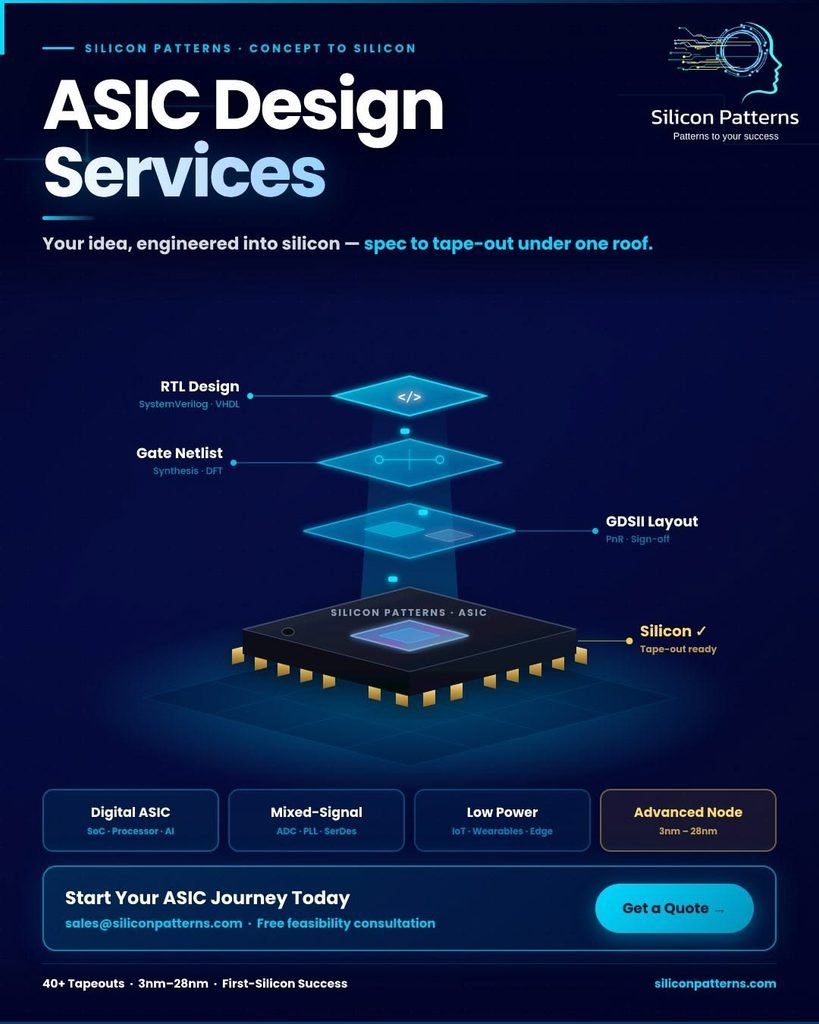
ASIC Development Process
Developing an ASIC involves several important stages.
First, engineers define the requirements of the chip. They then create the architecture and design the required circuits.
The design is simulated and tested to identify potential problems. After verification, the design is prepared for manufacturing.
The chip is then produced in a semiconductor fabrication facility. After manufacturing, the chips are tested to make sure they operate according to specifications.
This process requires significant technical expertise and investment.
ASIC vs FPGA
ASICs are sometimes compared with FPGAs, or Field-Programmable Gate Arrays.
An FPGA can be programmed and reconfigured after manufacturing. This makes it useful for development, prototyping, and applications where hardware flexibility is important.
An ASIC is manufactured for a specific purpose and generally provides better optimization for that purpose.
In simple terms:
- ASIC: Specialized and optimized hardware
- FPGA: Programmable and flexible hardware
- CPU: General-purpose processing
- GPU: Highly parallel processing for graphics and other workloads
The right option depends on the application’s performance, flexibility, cost, and power requirements.
Are ASICs Better Than CPUs and GPUs?
There is no single answer because each technology is designed for different purposes.
A CPU is useful when flexibility and general-purpose computing are important. A GPU is useful for workloads that benefit from massive parallel processing. An ASIC is useful when a specific workload needs highly optimized hardware.
Therefore, ASICs are not automatically better than CPUs or GPUs. Their main advantage is specialization.
Future of ASIC Technology
ASIC technology is expected to remain important as demand grows for specialized computing.
Artificial intelligence, networking, automotive electronics, telecommunications, and other technologies increasingly require hardware that can deliver high performance while controlling energy consumption.
Specialized processors and accelerators can help manufacturers meet these requirements.
Conclusion
An ASIC (Application-Specific Integrated Circuit) is a specialized chip designed for a particular application or workload. Its dedicated hardware can provide high performance, efficiency, and low power consumption for its intended purpose.
However, ASICs also involve higher development costs and less flexibility compared with CPUs and FPGAs. For this reason, they are most suitable when a specific workload is important enough to justify custom hardware.
From smartphones and networking equipment to automotive electronics and specialized computing, ASICs are an important part of modern technology.