
ROM, or Read-Only Memory, is one of the most important types of computer memory. It is used to store data and instructions that a computer or electronic device needs to operate. Unlike RAM, which temporarily stores information while a device is running, ROM can retain its data even when the power is turned off.
ROM has been used in computers, smartphones, gaming consoles, embedded systems, and many other electronic devices. Over the years, different types of ROM have been developed to provide better flexibility, performance, and data storage options.
In this guide, we will explain the main types of ROM memory, how they work, their advantages and disadvantages, and where they are commonly used.
What Is ROM Memory?
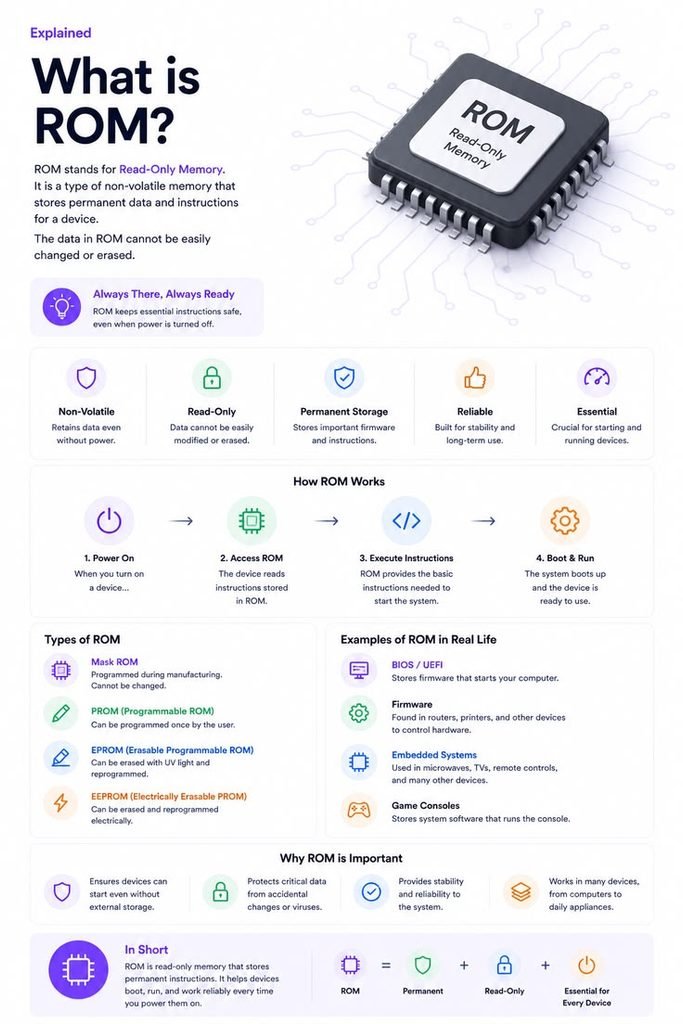
ROM stands for Read-Only Memory. It is a non-volatile memory, which means that it can retain stored information without a continuous power supply.
ROM is commonly used to store permanent or semi-permanent instructions such as firmware, boot programs, and other essential information required by electronic devices.
For example, when you turn on a computer, certain instructions are needed to start the system and check the hardware. These instructions can be stored in ROM or ROM-based memory.
The main characteristic of ROM is that its data is not normally changed as frequently as data stored in RAM.
Types of ROM
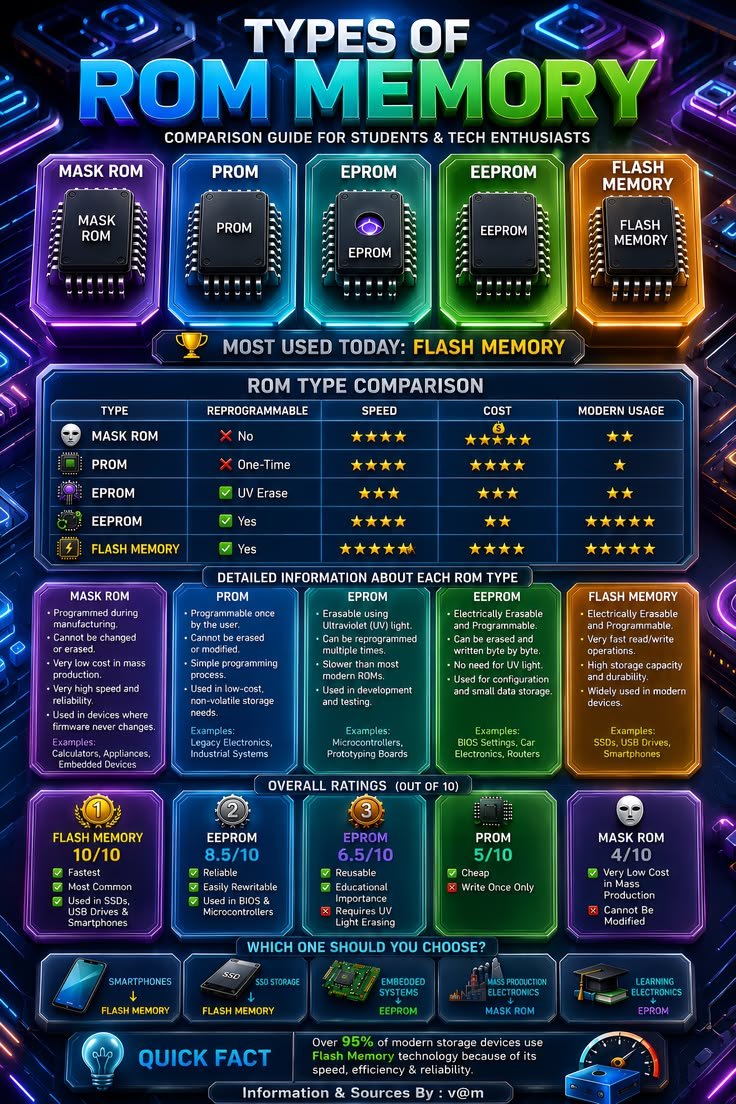
There are several important types of ROM memory. The most common types include:
- Mask ROM (MROM)
- PROM
- EPROM
- EEPROM
- Flash ROM
Let’s look at each type in detail.
1. Mask ROM (MROM)
Mask ROM, also known as MROM, is one of the earliest forms of ROM. Its data is permanently programmed during the manufacturing process.
The manufacturer creates the memory chip with specific information already stored inside it. Once the chip has been manufactured, the stored data cannot normally be changed.
Advantages of Mask ROM
- Data is permanently stored.
- It is reliable for mass-produced devices.
- It can be relatively inexpensive when produced in large quantities.
- It does not require power to retain data.
Disadvantages of Mask ROM
- Data cannot be changed after manufacturing.
- Creating custom chips can be expensive for small production runs.
- Any programming error may require a new chip design.
Uses of Mask ROM
Mask ROM was commonly used in older electronic devices, calculators, gaming systems, and appliances where the same program needed to be permanently stored.
2. PROM
PROM stands for Programmable Read-Only Memory.
Unlike Mask ROM, PROM can be programmed after the chip has been manufactured. However, it can normally be programmed only once.
A special programming device is used to write data to the PROM chip. After programming, the information becomes permanent.
Advantages of PROM
- Can be programmed after manufacturing.
- Useful for customized electronic devices.
- Data remains stored when power is removed.
- Programming is relatively straightforward with the proper equipment.
Disadvantages of PROM
- It cannot normally be erased.
- A programming mistake makes the chip unusable for that particular program.
- It is less flexible than EEPROM or Flash memory.
Uses of PROM
PROM can be useful in situations where a manufacturer needs to permanently program specific firmware or instructions into a device after production.
3. EPROM
EPROM stands for Erasable Programmable Read-Only Memory.
EPROM is more flexible than PROM because its stored information can be erased and replaced. Traditionally, EPROM chips were erased using ultraviolet (UV) light.
Many EPROM chips have a small transparent window on the top of the package. UV light can be used through this window to erase the stored data.
After erasing, the chip can be programmed again using a suitable programming device.
Advantages of EPROM
- Can be erased and reused.
- Useful during development and testing.
- Data can remain stored without power.
- More flexible than PROM.
Disadvantages of EPROM
- Requires special equipment for programming.
- Erasing can take time.
- The chip often needs to be physically removed for erasing.
- UV light is required for traditional EPROM erasure.
Uses of EPROM
EPROM was widely used during the development of computer hardware, firmware, and embedded systems. Engineers could test software, erase the chip, and program it again.
4. EEPROM
EEPROM stands for Electrically Erasable Programmable Read-Only Memory.
EEPROM improved upon EPROM because its data can be erased electrically instead of requiring ultraviolet light.
One of its major benefits is that it can be reprogrammed while installed in a device, depending on the system design.
EEPROM is often used for storing small amounts of configuration data, settings, and firmware.
Advantages of EEPROM
- Can be electrically erased.
- Can be reprogrammed multiple times.
- Does not require UV light.
- Can be updated while installed in a device.
Disadvantages of EEPROM
- Write operations can be slower than reading.
- It has a limited number of write/erase cycles.
- Usually provides less storage capacity than modern Flash memory.
Uses of EEPROM
EEPROM can be found in embedded systems, microcontrollers, computers, industrial equipment, and electronic devices that need to save configuration settings.
For example, a device may use EEPROM to store calibration information or settings that need to remain available after the power is turned off.
5. Flash ROM
Flash memory is a type of electrically erasable non-volatile memory that has become extremely common in modern electronics.
Flash memory can store larger amounts of information than traditional EEPROM and can be erased and rewritten electronically.
There are two major types of Flash memory:
- NAND Flash
- NOR Flash
NAND Flash is commonly used for high-capacity storage such as SSDs, USB drives, and memory cards. NOR Flash is often used for firmware and applications where fast random access to stored instructions is important.
Advantages of Flash Memory
- Non-volatile storage.
- Can be electrically erased and rewritten.
- Available in high capacities.
- Compact and energy efficient.
- Widely supported by modern electronic devices.
Disadvantages of Flash Memory
- Flash cells have a limited number of write/erase cycles.
- Performance can vary depending on the type of Flash memory.
- Data management requires specialized memory controllers in many applications.
Uses of Flash Memory
Flash memory is used in:
- SSDs
- USB flash drives
- Memory cards
- Smartphones
- Digital cameras
- Embedded systems
- Routers
- Gaming devices
- Firmware storage
ROM vs RAM
ROM and RAM are both important types of computer memory, but they serve different purposes.
ROM is non-volatile, so it can retain data when the device is turned off. It is generally used for firmware and other persistent instructions.
RAM, on the other hand, is volatile memory. It temporarily stores data and programs that the processor is actively using. When the power is removed, the information stored in RAM is normally lost.
In simple terms, ROM helps a device remember essential instructions, while RAM provides temporary working space for running programs.
Why Is ROM Important?
ROM is important because electronic devices need certain instructions to start and operate correctly. Without persistent memory, many devices would have difficulty retaining essential firmware and configuration information.
Modern ROM technologies also provide flexibility. Instead of permanently fixing all information during manufacturing, technologies such as EEPROM and Flash allow manufacturers to update firmware when necessary.
This is particularly useful for modern computers, smartphones, routers, vehicles, and IoT devices.
Conclusion
ROM memory has evolved significantly from traditional Mask ROM to modern Flash memory. Each type was developed to solve specific limitations of earlier technologies.
Mask ROM provides permanent factory-programmed data, while PROM allows one-time programming. EPROM can be erased using UV light, and EEPROM can be electrically erased and rewritten. Modern Flash memory provides high-capacity, efficient, and flexible non-volatile storage.
Understanding the different types of ROM memory is useful for anyone interested in computers, electronics, embedded systems, and hardware. Although modern devices often use advanced Flash-based technologies instead of traditional ROM, the basic principles of ROM remain an important part of computer architecture.